Global Market Disruptions & Valuation Considerations
Summary
Global markets have faced multiple crises in recent periods. Trade policy uncertainty has been followed by software market volatility driven by AI disruption, resulting in significant turmoil across regions. This has been further intensified by geopolitical conflict in the Middle East, leading to energy supply disruptions, elevated inflation and increased recession risk. Together, these factors point to continued macroeconomic volatility, slower growth and regulatory uncertainty.
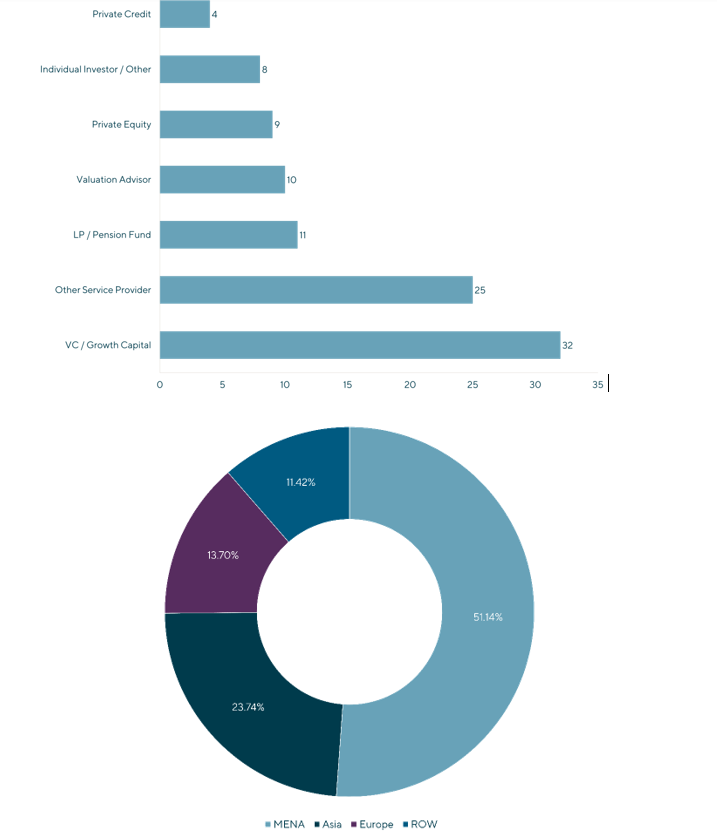
In April 2026, Lincoln International hosted a webinar with the Middle East Venture Capital Association (MEVCA) to explore the implications for private capital valuations. The discussion covered key challenges, investor considerations, best practices for fair value determination in volatile markets, impacts on early and growth investors, global guidance and lessons from international markets.
The session attracted over 150 participants, with 65% from the investment community and the remainder being service providers. More than 50% focused on the GCC and MENA region, followed by Asia (24%), Europe (14%) and other regions.
Participant Demographics & Geographic Focus
A More Complex Macro Environment & Energy Crisis
Markets are being shaped by geopolitical tensions, energy disruptions and evolving trade and monetary policies.
Disruptions to key energy routes, such as the Strait of Hormuz, which accounts for approximately 20% of global oil supply, are creating ripple effects across industries, with higher energy prices impacting costs and operations. At the same time, persistent inflation and elevated interest rates are increasing discount rates and cost of capital, while tighter financial conditions are reducing access to financing and deal activity.
These dynamics are driving higher volatility and more cautious investor sentiment. As a result, valuations are increasingly reflecting uncertainty through multiple compression and greater dispersion, requiring more asset-specific analysis rather than broad sector assumptions.
Technology Disruption and Software Market Reset
Technology remains a core investor focus, particularly due to rapid AI advancements, though market trends indicate a more nuanced outlook over the near to medium term. While capital continues to be deployed into high-quality, AI-enabled businesses, including those supporting AI infrastructure such as data centers and compute capacity, investors are becoming more selective, with increased focus on growth durability, capital efficiency and underlying return profiles.
Software valuations have come under pressure, with multiple compression driven by growth uncertainty and AI disruption. Public market data suggests this pullback is more linked to long-term expectations than near term performance. Investors are therefore placing greater emphasis on growth quality, margin sustainability, capital efficiency and AI readiness.
The market is also becoming more selective, with a clear divide between technology companies with strong fundamentals and defensible positioning versus less-differentiated players. Businesses with high switching costs, strong customer relationships and embedded workflows continue to attract capital.
Implications for the GCC
The GCC retains strong medium- to long-term fundamentals, supported by diversification agendas and capital availability. Key trends include:
Capital deployment: Shift toward larger, sponsor-backed deals, with moderation in early-stage investments
Sector focus: Continued investment in high-growth sectors such as technology, fintech, logistics and climate tech
Risk and sentiment: Increased investor caution and selectivity
Exit dynamics: Shift toward more structured liquidity routes, including strategic sales and secondary transactions rather than reliance on IPO markets
Valuation Challenges
In the current environment, valuers, investors and other stakeholders face several challenges as conditions become more volatile and uncertain. Key themes include:
Increased uncertainty and market volatility: Driving more dynamic valuation outcomes and greater reliance on judgment
Multiple compression and dispersion: Requiring asset-specific analysis rather than broad sector assumptions
Predicting Outcomes: Needed to assess a range of outcomes and reflect evolving conditions
Sector-specific considerations: Including exposure to energy costs, supply chain disruption and AI-driven business model changes
Governance and transparency: Greater need for robust frameworks, clear assumptions and alignment with market participant views
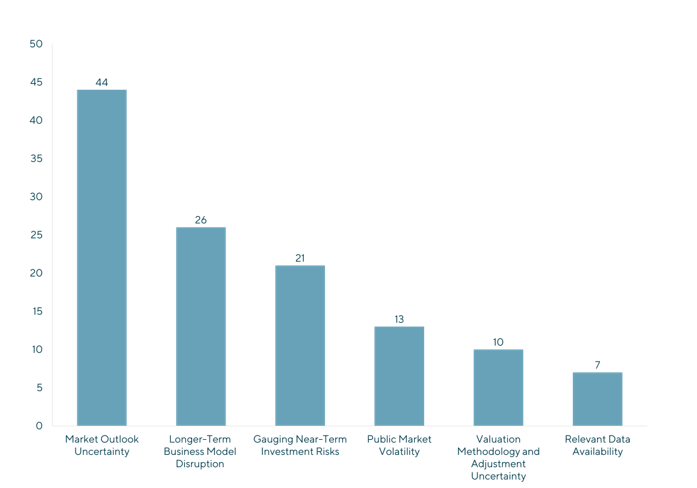
These themes align with findings from a live audience poll. Participants cited uncertainty in market outlook (36%) and long-term business model disruption (21%) as the most significant challenges, followed by difficulty in assessing near-term risks (17%) and public market volatility (11%). Other concerns included uncertainty around valuation methodologies and limited comparable data. This reinforces the importance of incorporating forward looking considerations and robust analytical frameworks.
Most Significant Challenges Identified by Participants
Key Considerations for Investors and Valuers and Importance of Strong Valuation Framework
There is an increased focus on applying disciplined valuation frameworks. Key considerations include:
Fair value framework: Reflects the price in an orderly transaction based on market participant assumptions and should not be interpreted as distressed pricing
Use of relevant information: Based on information known or knowable at the valuation date, avoiding hindsight
Impact assessment: Incorporating effects of market disruption on revenues, customers, supply chains and operations
Scenario analysis: Assessing uncertainty around timing and severity of disruptions
Governance and transparency: Ensuring consistency with best practices and global valuation standards
Key Takeaway
Market volatility is increasingly becoming the norm, with shorter business cycles and more frequent disruptions. In this environment, valuations should reflect conditions as of the valuation date, focusing on known and knowable information rather than hindsight.
There is growing emphasis on governance, transparency and robust valuation approaches, alongside appropriate methodologies including scenario-based analysis where relevant. As standards evolve, valuation practices are shifting away from rigid rule-based approaches toward more principle-based frameworks involving deeper judgement, supported by global best practice guidance.
With the rapid changes, growth and development seen in the global and MENA markets, a strong strategy and a trusted partner are crucial for investors and management teams alike. Reach out to Lincoln International’s valuation experts to discuss your best path to informative and accurate valuations in 2026 and beyond.